
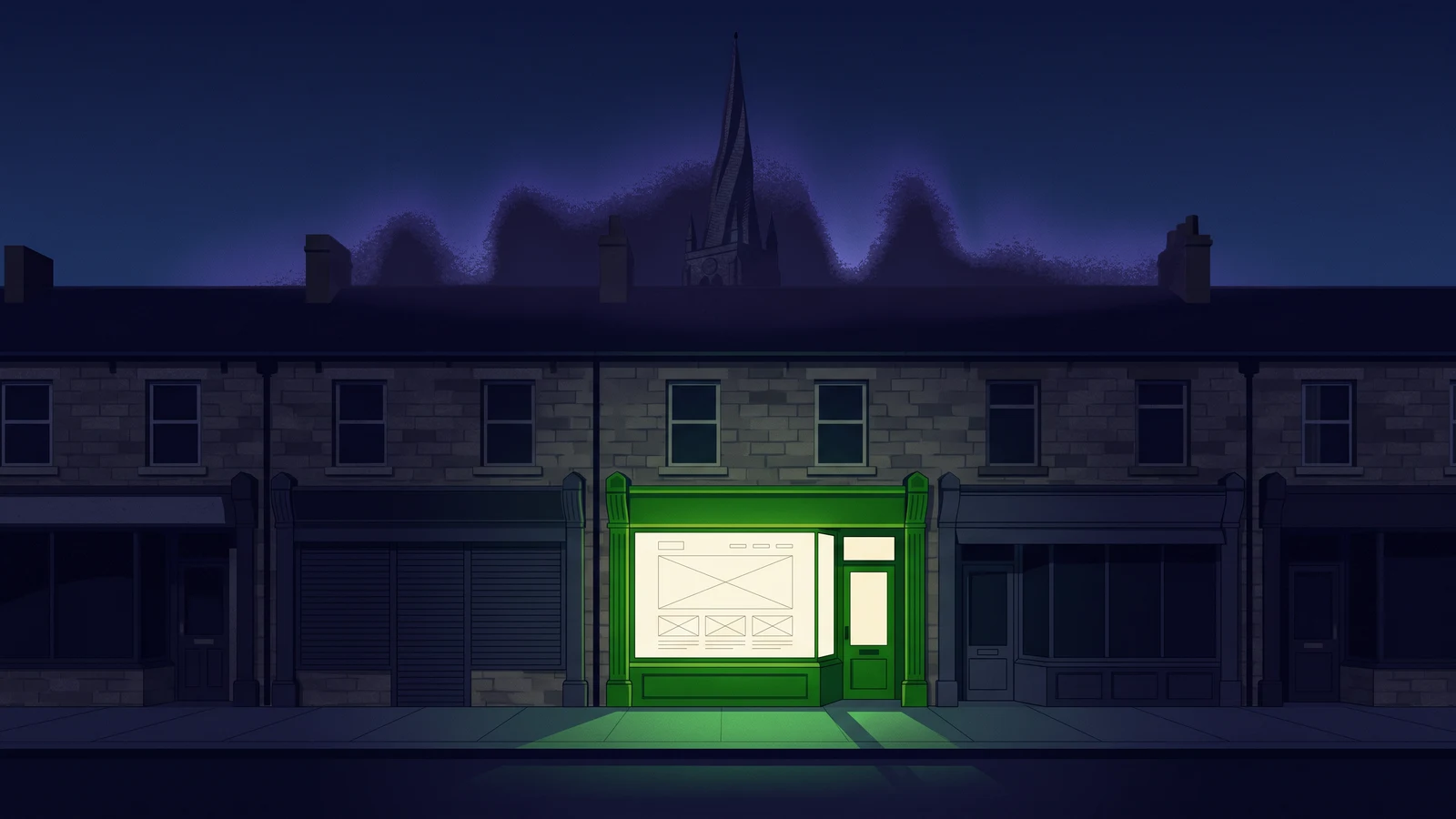
I have been building websites in and around Chesterfield since 2010, which means I have seen most of the ways local businesses go about getting one. Some routes work well. Some quietly waste a few thousand pounds. And which is right depends far more on your situation than on anything a salesperson tells you.
So here is the honest map of the options, from someone with an obvious stake in one of them. I will tell you where that stake is as we go, and where the other routes genuinely make more sense.
What Chesterfield businesses actually have to choose from
Strip away the branding and there are four routes: a design agency, an independent developer or freelancer, a DIY website builder, or the “someone’s nephew” option that I will spare you a section on beyond saying that the rebuild work it generates keeps people like me busy.
The interesting part is that all four exist locally. Chesterfield and the surrounding towns have proper agencies, established independents, and plenty of businesses running self-built sites. None of these routes is wrong. They are priced and shaped for different situations.
The agency route
An agency gives you a team: account manager, designer, developer, sometimes a copywriter. For larger projects, that structure earns its money, and if your project genuinely needs four specialists at once, an agency is the right call.
What you should know is what the structure costs. Agency pricing around North Derbyshire and Sheffield typically starts well above independent rates for the same build, because you are funding the office, the account layer and the sales function alongside the work. The person who impressed you in the pitch meeting is also usually not the person building your site.
For a Chesterfield business wanting a solid brochure site or an online shop, the agency premium often buys process rather than a better website. Sometimes process is what you need. Often it is not.
The independent developer route
This is my lane, so weigh what follows accordingly.
An established independent gives you the same person in the pitch, the build and the phone call a year later. Overheads are lower, so prices are lower for the same quality of work; mine are published, from £2,000 for a business site. The trade-off is capacity: one person cannot be four, which is why the sensible questions to ask any independent are about cover, timescales and what happens when they are on holiday. I keep a small team behind me for exactly that reason, and I have written a full guide to vetting a developer that applies to me as much as anyone.
The local part matters more than people expect. Not because websites care about geography, but because accountability does. A developer with a 01246 number, a visible local trading history and clients you can actually ring is taking a reputational risk a distant contractor is not. In a town this size, word travels, and that keeps standards honest.
The DIY route
Wix, Squarespace, GoDaddy and friends, from roughly £15 a month. I will say what plenty of developers will not: for a brand-new Chesterfield business testing an idea, DIY is often the right first move. A market trader, a new dog groomer, a side project. Spend the £15, not the £2,000, until the idea proves itself.
The honest limits: you are the designer and developer now, the site will look like the template because it is one, and ranking on Google for anything competitive is genuinely difficult on these platforms. The moment the website needs to win work rather than just exist, the DIY maths flips, and the £2,000 build that brings in two customers a month becomes the cheap option.
What “web design” should actually include
Whichever route you pick, the quote should cover more than something that looks nice. A site that earns for a Chesterfield business needs to load quickly, work properly on phones, be findable when someone searches for what you do in the area, and be editable by you without breaking. It should collect enquiries reliably and tell you where they came from.
Those are the checklist items that separate a £2,000 site from a £500 one, and they are worth asking about directly, because at the cheap end they are the first things quietly left out. I build on WordPress because it does all of the above without renting your own website back to you, but the checklist applies whatever the platform.
A rough guide to local money
Numbers vary, but for orientation: DIY builders run £10 to £30 a month plus your evenings. Template-based local providers sit in the £500 to £1,500 range. Established independents around Chesterfield and Sheffield generally start bespoke work somewhere between £2,000 and £4,000; mine starts at £2,000, e-commerce at £4,500. Agencies typically open at £5,000 and climb quickly.
The pattern worth noticing: each tier roughly doubles the last, and what you are buying with each doubling is thinking, accountability and aftercare rather than prettier pixels. Where your business sits on that ladder is a budgeting decision only you can make, but at least make it with the real ladder in view.
The short version
Testing an idea: DIY, honestly and cheaply. Established business that needs a site to win work: an independent gives you the best value per pound, and being local adds accountability you cannot invoice for. Big multi-stakeholder project: an agency’s structure starts earning its premium.
I am the middle option, based here in Chesterfield, and the local page has the details: the work, the reviews, and how a project starts. If you are still weighing routes, a conversation costs nothing and I will tell you if DIY is the right answer for where you are.
Common questions
How much does web design cost in Chesterfield?
For bespoke work from an established local developer, budget from around £2,000 to £4,000 for a business site; my published starting point is £2,000. Agencies open higher, templates and DIY sit lower with the trade-offs described above. The full pricing breakdown covers what moves the number.
Do I need a local web designer, or does location not matter?
The build travels fine either way. What local gets you is accountability: a trading history you can check, clients you can ask, and someone who will sit across a table from you when it matters. For a lot of Chesterfield businesses that is worth real money; for others a good remote developer is fine.
How long does a website take to build?
For a bespoke business site, typically three to six weeks, and the most common delay is content, your words and photos, rather than the build itself.
Can you improve my existing site instead of rebuilding it?
Often, yes. Repairing, speeding up and extending existing WordPress sites is a steady part of my work, and the honest starting point is an assessment of whether the site is worth repairing or better rebuilt.
What areas do you cover?
Chesterfield is home, and I work across the surrounding towns and Derbyshire: Dronfield, Bolsover, Clay Cross, Matlock and beyond, plus remote work UK-wide. The locations pages list the areas properly.