
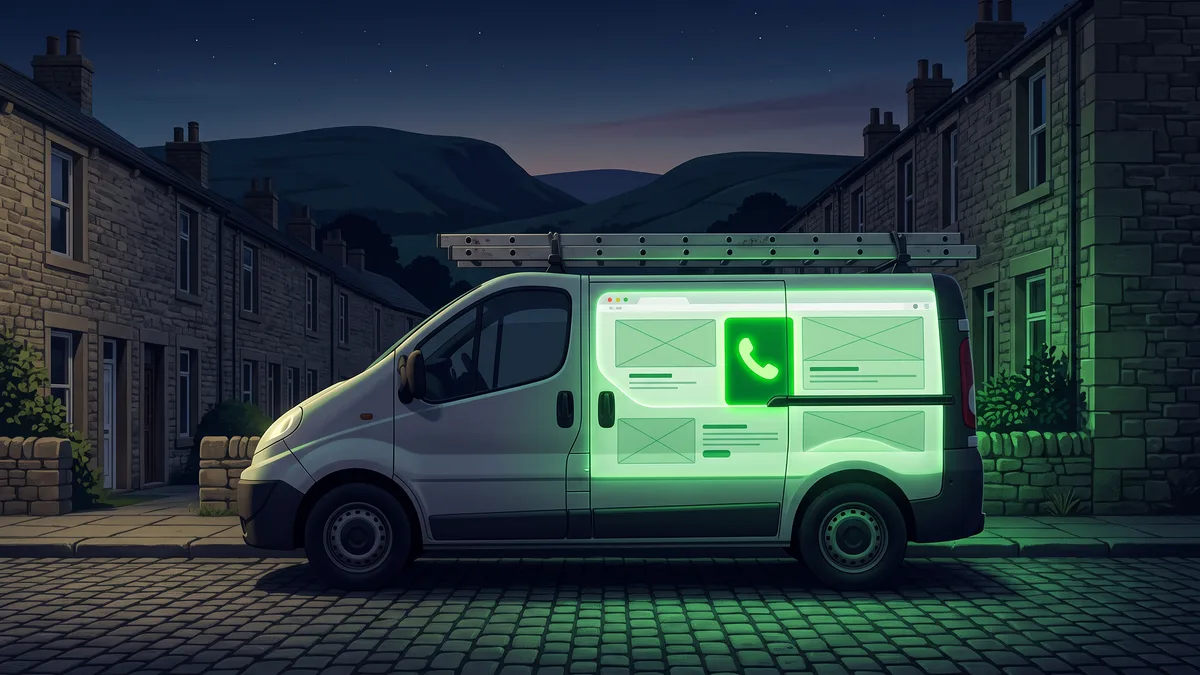
A fair share of my work comes from tradespeople: builders, electricians, plumbers, joiners, landscapers, working out of vans across Derbyshire and the towns around it. Their websites have taught me something the design industry rarely admits: most trade websites are built to impress other designers, and the ones that actually win work are built around how customers really hire a trade.
So this is the honest version of what a trade website needs, from someone who has built plenty and seen what the enquiry numbers reward.
How people actually hire a trade
Nobody browses builders for fun. The visit happens at a moment of need, often on a phone, often mid-recommendation: someone was given your name, or found you searching “electrician near me” with a socket hanging off the wall. They are there to answer three questions: do you do the thing I need, do you cover my area, and can I trust you enough to ring.
Everything on the site serves those three questions or it is decoration. Which leads to the first rule.
Phone first, everything else second
For a trade, the website’s conversion is a phone call. The number belongs at the top of every page, tappable, big enough for a thumb. A contact form is the backup for evening browsers, not the main event, and it needs to actually deliver its messages, which is checked less often than you would think.
And because the visit is on a phone, probably on a patchy mobile signal somewhere outside Clay Cross, the site has to be light and fast. A heavy site that takes eight seconds on 4G is a customer ringing the next name on the list. This is where speed stops being a technical nicety and becomes the difference between jobs.
Real photos beat everything
The single strongest content on a trade site is photographs of your actual work. Not stock photos of a smiling model in a hard hat, which customers detect instantly and which quietly say “we had nothing real to show”. Before-and-afters, finished jobs, tidy vans, real sites.
The bar is low: phone photos, taken in decent light, of work you are proud of. Ten real photos outperform any amount of copywriting, because they answer the trust question directly. Pair them with reviews, ideally Google reviews the customer can verify, and the site has done its persuading.
Say your towns, properly
“Covering Derbyshire” is true and useless: nobody searches for it. Customers search their town. A trade site should name the places you genuinely work, Chesterfield, Dronfield, Belper, Worksop, Mansfield, wherever your van actually goes, and the towns you most want work in deserve more than a name in a list.
This is the same logic I apply to my own business, town by town, across the same map, and it works for exactly the same reason: search engines connect people to places, and a page that speaks about a real town, with real knowledge of it, beats a generic one every time. The trade businesses I have built for around Belper and Worksop compete on precisely this.
What it should cost, and what to avoid
A trade website does not need to be expensive, because it does not need to be big: a strong front page, work photos, areas covered, reviews and a contact page will win work for most trades. That puts an honest build at the lower end of normal pricing, and well within the range where it pays for itself with a couple of jobs.
The traps are the industry-specific ones. Directory sites that rent you leads shared with three competitors. “Free” website schemes where the provider owns your domain and your Google listing, which you discover when you try to leave. Monthly-fee template mills where four other electricians in the county have your exact site. The ownership test cuts through all of it: if you stopped paying tomorrow, would you still own the domain, the site and the phone number on it? If not, walk away.
Kept simple, kept working
The final requirement is that the site keeps working without becoming your second job. You are on the tools all day; the site needs someone keeping it updated and backed up, and adding a new job photo should be a five-minute task from your phone, not a phone call to a designer who has moved on.
That is the whole formula: phone-first, fast on mobile, real photos, real reviews, real towns, owned outright, quietly maintained. None of it is glamorous. All of it wins work, which is the point.
Common questions
I get all my work from word of mouth. Do I need a website at all?
Word of mouth now ends at a search: someone is given your name and looks you up before ringing. No site, or a bad one, leaks a share of those warm recommendations to whoever looks more established. The site’s job is to not fumble the reputation you already earned.
What about Checkatrade and the directory sites?
They can bring work, and plenty of trades use them alongside their own site. The problem is building your whole presence on rented ground: shared leads, their branding, their rules. Your own site is the asset you keep; directories are advertising you can take or leave.
Can you make my site show up in every town I cover?
Honestly: showing up strongly in a handful of genuinely-served towns is achievable; blanketing the county is not, and anyone promising it is selling something. Naming your real towns, gathering reviews from customers in them, and keeping your Google Business Profile accurate does more than any trick.
How quickly can a trade website be built?
Faster than most, because the sites are focused: typically within my normal three to six week window, and the pace usually depends on how quickly the photos and review links arrive rather than the build.
I’m not good with computers. Will I be able to update it?
That is a design requirement, not a limitation. A properly set up WordPress site gives you exactly the controls you need, adding photos, editing hours, and nothing you can break. Sitting down together until you are comfortable is part of the job, and being based in Chesterfield, for local trades that happens across a table.